An Elementor form can show a successful submit while the webhook receiver rejects the payload, ignores a renamed field, or never receives the request. The debug path needs request shape, headers, response code, and retry behavior.
Use this when Elementor Forms, popup forms, CRMs, Zapier, Make, custom endpoints, or lead-routing systems miss submissions.
Quick answer
Elementor Form Webhook Format Debug Checklist should be handled with a narrow evidence-first workflow: check submit actions, freeze field ids, capture payload, then verify the result before making broader changes.
What to check first
- Confirm Actions After Submit includes the webhook action for the correct form.
- Record the exact field IDs, not only visible labels.
- Capture request headers, body shape, status code, and receiver response.
- Check spam, honeypot, captcha, and conditional logic paths separately.
- Send a controlled test lead and compare it against a real failed lead.
Diagnostic table
Use this table to keep the work practical. It connects the symptom to evidence and a verification step.
| Action | Evidence to collect | How to verify |
|---|
| Check submit actions | Confirm Actions After Submit includes the webhook action for the correct form. | The webhook action fires on the correct Elementor form. |
| Freeze field IDs | Record the exact field IDs, not only visible labels. | The receiver log shows the same field IDs that WordPress sent. |
| Capture payload | Capture request headers, body shape, status code, and receiver response. | Failed requests return a status code and body that can be reviewed. |
| Test spam paths | Check spam, honeypot, captcha, and conditional logic paths separately. | CRM mapping survives popup and embedded form versions. |
Useful command or data shape
Adapt paths, IDs, and privacy handling to the site before running commands or storing data on production.
curl -sS -X POST https://example-crm.test/webhook \
  -H 'Content-Type: application/json' \
  -d '{"form_id":"contact","fields":{"email":"test@example.com","gclid":"TEST"}}'
Safe fix order
Do the work in a sequence that makes each result easy to prove. Stop if a step produces new evidence that changes the incident scope.
- Check submit actions
- Freeze field IDs
- Capture payload
- Test spam paths
- Compare receiver logs
Production verification checklist
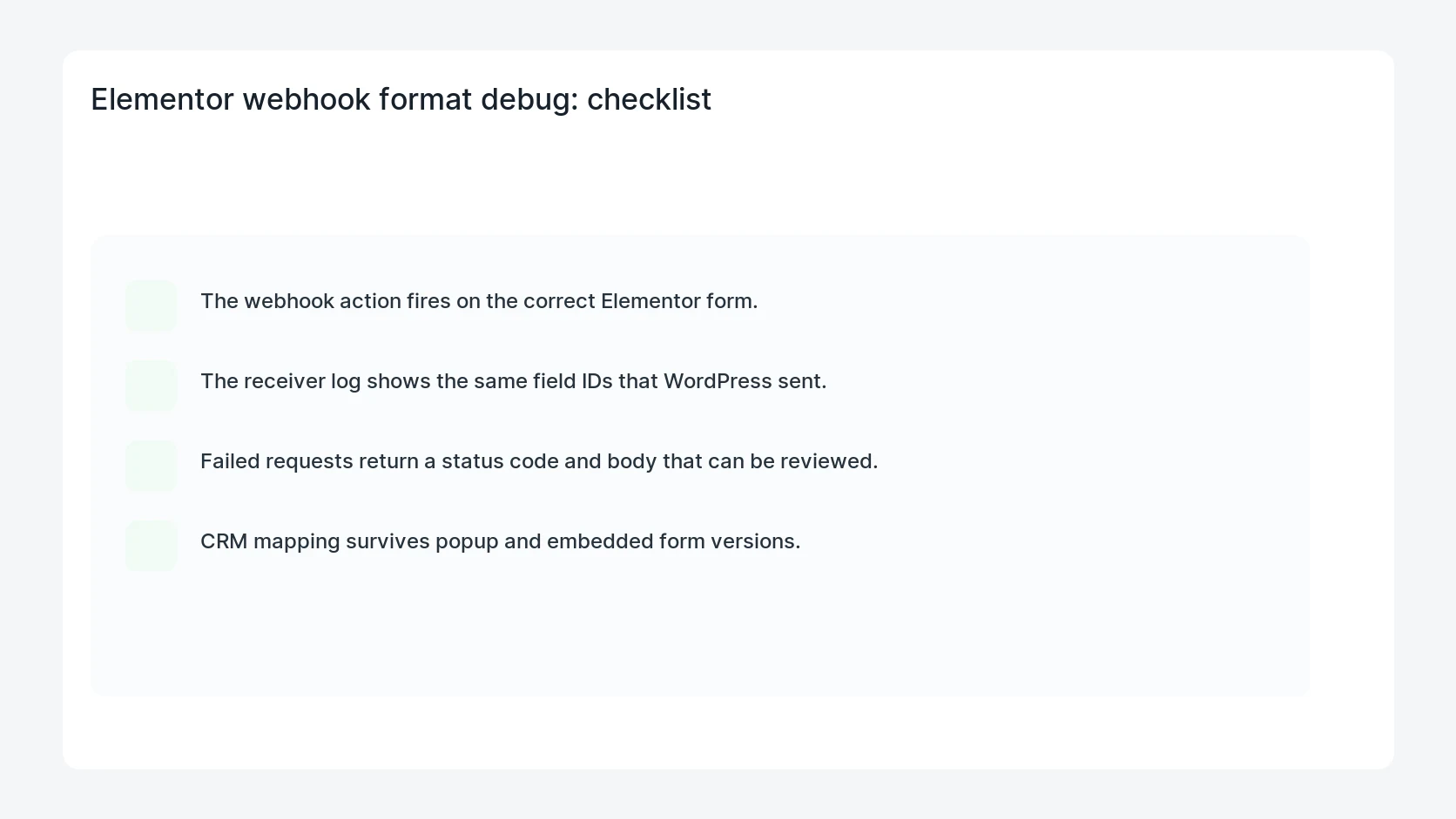
- The webhook action fires on the correct Elementor form.
- The receiver log shows the same field IDs that WordPress sent.
- Failed requests return a status code and body that can be reviewed.
- CRM mapping survives popup and embedded form versions.
Mistakes to avoid
- Do not judge the fix by one browser or the homepage only.
- Do not delete evidence before recording usernames, file paths, timestamps, and response headers.
- Do not add a cache, security, or tracking plugin while the original problem is still unclear.
- Do not leave test users, temporary debug logs, or broad API keys active after verification.
When HandL WP should help
Bring in help when this affects leads, checkout, search visibility, malware risk, paid media reporting, or a client production site. HandL WP can trace the issue through WordPress, hosting, cache, tracking, and Search Console, then verify the workflow after the technical fix.
If this is active on a production site, fix Elementor form integrations.
Helpful references