A sitemap and an llms.txt file are not interchangeable. One is an established discovery file for search crawlers. The other is a proposed Markdown guide that can point AI systems to useful content.
Use this if a WordPress site wants AI search visibility without breaking normal indexing or confusing crawl controls.
Quick answer
Start with evidence, not a plugin setting. The first useful checks are: Keep XML sitemap focused on canonical indexable URLs. Use llms.txt to curate important pages, descriptions, docs, and service context. Do not put private content, secrets, or unpublished drafts in either file. Keep every change small enough to reverse.
Fast diagnosis map
Use this map before changing production. It helps separate a real platform issue from a cached page, stale setting, or missing handoff.
| Signal | What it means | Useful next check |
|---|
| llms.txt submitted as sitemap | Check access, users, or ownership first | Keep sitemap canonical |
| Sitemap missing blog URLs | Look for a configuration, plugin, or data mismatch | Use llms.txt as curated guide |
| AI file has stale links | Inspect the layer most likely to be hidden from the normal UI | Refresh after launches |
| Robots blocks public pages | Prove whether the problem is still active | Avoid private URLs |
What to check first
- Keep XML sitemap focused on canonical indexable URLs.
- Use llms.txt to curate important pages, descriptions, docs, and service context.
- Do not put private content, secrets, or unpublished drafts in either file.
- Update both files when major service pages, docs, or high-value posts change.
- Check that clean blog URLs and .html prerendered URLs do not compete as canonicals.
Run a focused check
These commands or fields give you a useful starting point. Adapt paths, IDs, and privacy handling to the site before running anything on production.
# /llms.txt
# HandL WP

> WordPress maintenance, malware cleanup, WooCommerce support, and conversion tracking help.

## Core pages
- [WordPress Care Plans](https://example.com/care-plans): Maintenance, monitoring, backups, and update support.
- [Malware Cleanup](https://example.com/fix/wordpress-malware-removal): Emergency cleanup for hacked WordPress sites.
- [WooCommerce Support](https://example.com/woocommerce-support): Store debugging, checkout fixes, and tracking repair.
Safe fix order
Do the work in this order so each result can be verified. If a step fails, stop and capture the evidence before making a broader change.
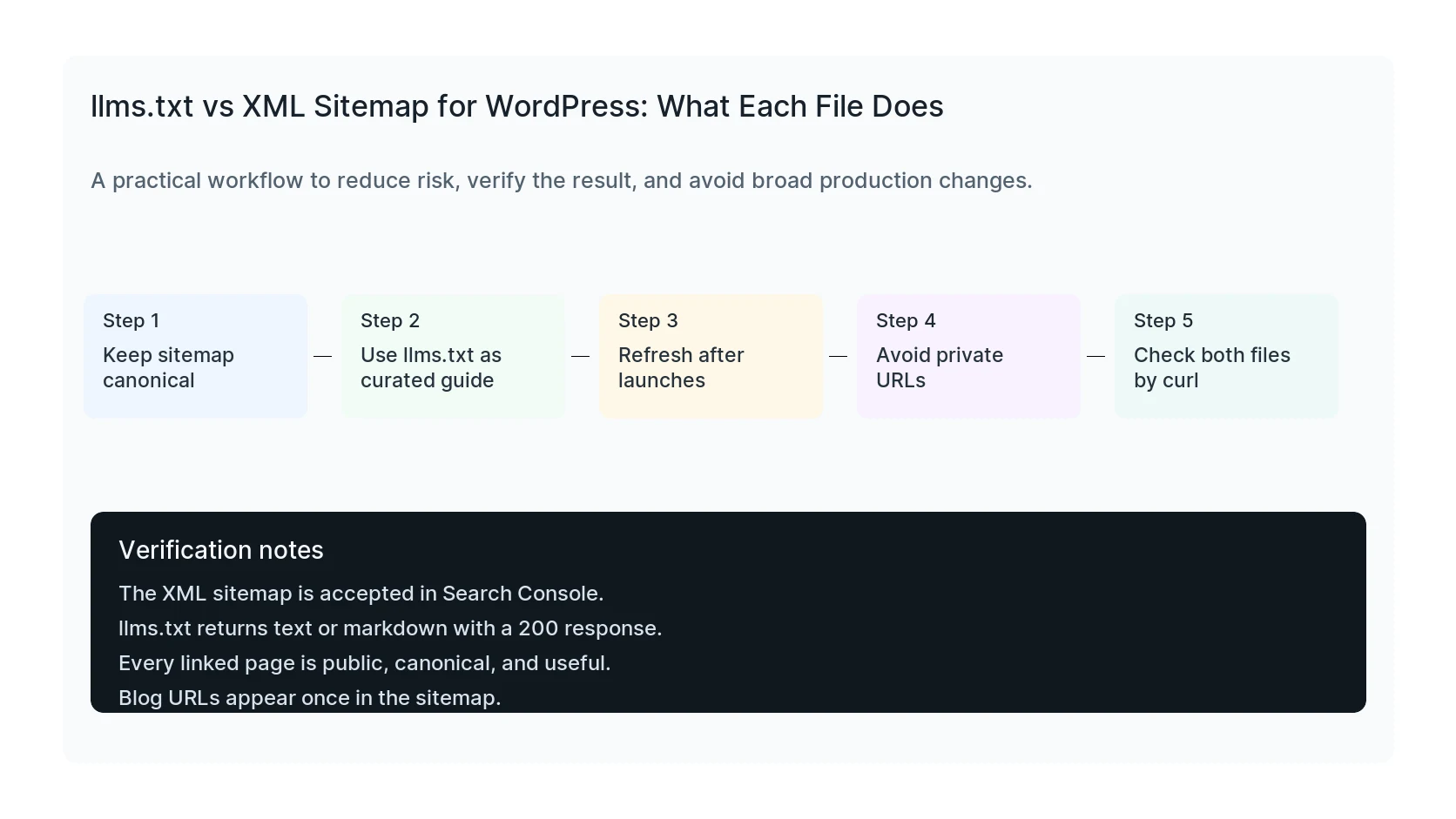
- Keep sitemap canonical
- Use llms.txt as curated guide
- Refresh after launches
- Avoid private URLs
- Check both files by curl
Verification checklist
The fix is not done when the warning disappears. Confirm the result from the visitor side, admin side, and reporting side.
- The XML sitemap is accepted in Search Console.
- llms.txt returns text or markdown with a 200 response.
- Every linked page is public, canonical, and useful.
- Blog URLs appear once in the sitemap.
Mistakes to avoid
- Do not judge the result by the homepage only.
- Do not clear every cache layer until you know which layer affects the symptom.
- Do not delete evidence before copying filenames, timestamps, versions, and affected URLs.
- Do not make privacy or crawler decisions without writing down the business reason.
- Do not leave temporary debug settings, test accounts, or broad permissions in place.
When HandL WP should help
Bring in help when the issue affects leads, checkout, ads, malware risk, search visibility, or a client production site. HandL WP can trace the problem through WordPress, hosting, tracking, cache, and Search Console, then verify the business workflow after the technical fix.
If this is active on a production site, prepare WordPress content for AI search.
Helpful references