Post-cleanup monitoring is the part that proves a WordPress supply chain incident is actually over. If the site had OptinMonster, TrustPulse, or PushEngage loaded during the June 2026 CDN incident, do not stop after deleting one suspicious plugin or user.
Use this for business sites, agency-managed sites, and WooCommerce stores that already did the first cleanup pass and now need a short monitoring plan.
Quick answer
OptinMonster, TrustPulse, and PushEngage Post-Cleanup Monitoring should be handled with a narrow evidence-first workflow: confirm clean state, purge cache layers, watch new changes, then verify the result before making broader changes.
What to check first
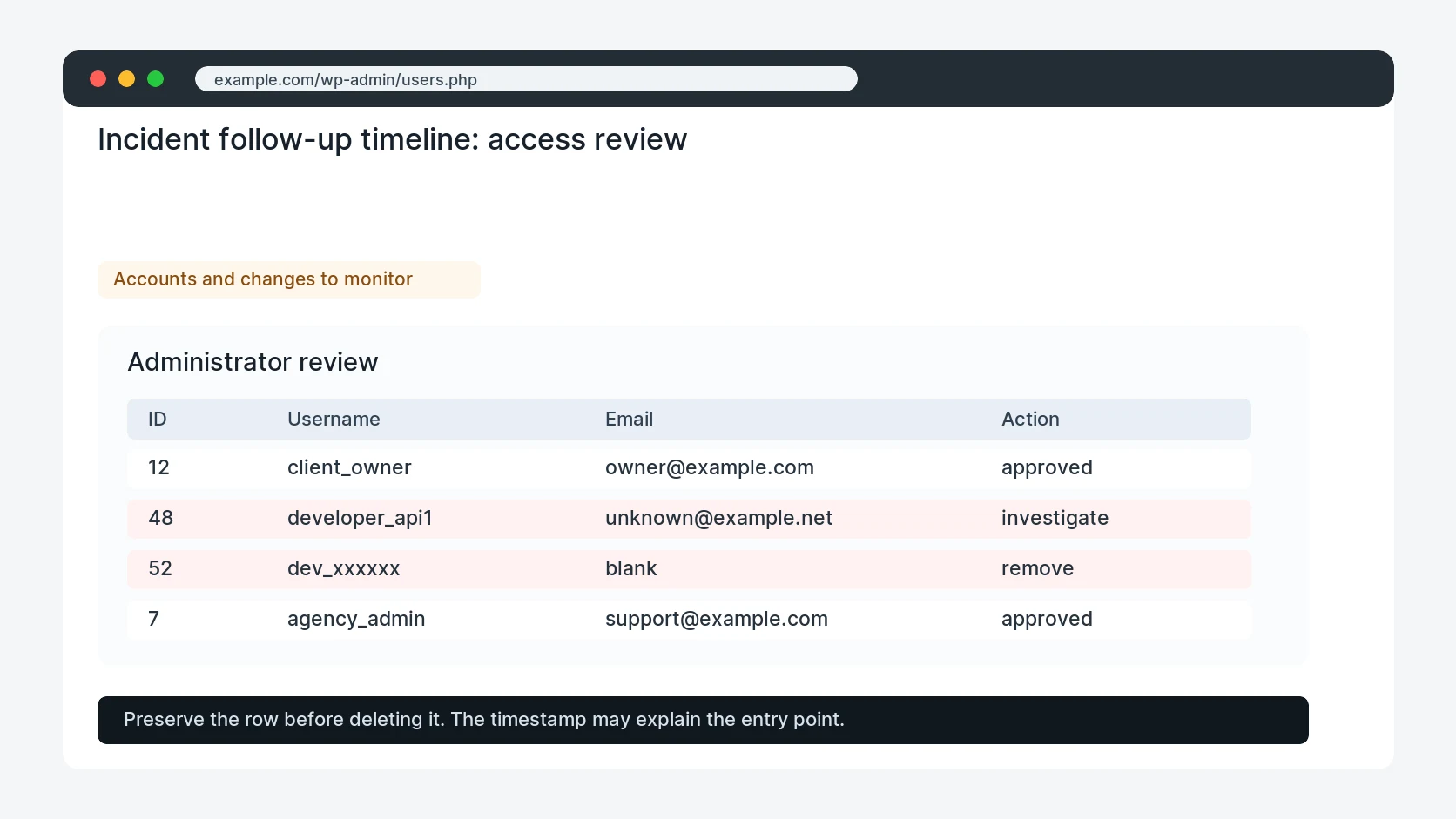
- Recheck administrator users from WP-CLI and compare them to the approved access list.
- Search plugin folders and mu-plugins for hidden loaders or renamed helpers.
- Purge CDN and page cache after file cleanup so old JavaScript is not still served.
- Review access logs for repeat hits to removed files or suspicious admin paths.
- Set a 7 day watch for new admin users, plugin installs, and changed PHP files.
Diagnostic table
Use this table to keep the work practical. It connects the symptom to evidence and a verification step.
| Action | Evidence to collect | How to verify |
|---|
| Confirm clean state | Recheck administrator users from WP-CLI and compare them to the approved access list. | No unapproved admin accounts exist after 7 days. |
| Purge cache layers | Search plugin folders and mu-plugins for hidden loaders or renamed helpers. | No removed plugin folder or indicator returns on disk. |
| Watch new changes | Purge CDN and page cache after file cleanup so old JavaScript is not still served. | CDN and page cache serve current JavaScript only. |
| Review logs daily | Review access logs for repeat hits to removed files or suspicious admin paths. | The final note lists users, files, cache layers, logs, and dates checked. |
Useful command or data shape
Adapt paths, IDs, and privacy handling to the site before running commands or storing data on production.
wp user list --role=administrator --fields=ID,user_login,user_email,user_registered
find wp-content -type f -mtime -7 -name '*.php' -print
find wp-content/plugins wp-content/mu-plugins -maxdepth 3 -type f | grep -Ei 'database-optimizer|content-delivery-helper|developer_api1'
wp cache flush
Safe fix order
Do the work in a sequence that makes each result easy to prove. Stop if a step produces new evidence that changes the incident scope.
- Confirm clean state
- Purge cache layers
- Watch new changes
- Review logs daily
- Close with evidence
Production verification checklist
- No unapproved admin accounts exist after 7 days.
- No removed plugin folder or indicator returns on disk.
- CDN and page cache serve current JavaScript only.
- The final note lists users, files, cache layers, logs, and dates checked.
Mistakes to avoid
- Do not judge the fix by one browser or the homepage only.
- Do not delete evidence before recording usernames, file paths, timestamps, and response headers.
- Do not add a cache, security, or tracking plugin while the original problem is still unclear.
- Do not leave test users, temporary debug logs, or broad API keys active after verification.
When HandL WP should help
Bring in help when this affects leads, checkout, search visibility, malware risk, paid media reporting, or a client production site. HandL WP can trace the issue through WordPress, hosting, cache, tracking, and Search Console, then verify the workflow after the technical fix.
If this is active on a production site, get WordPress malware cleanup help.
Helpful references