WooCommerce Abilities API work can make extension actions easier to expose to tools and assistants. A useful security review starts with one question: can the user or credential behind the tool do only what the store would normally allow that role to do?
Use this for WooCommerce stores that use application passwords, external automation, AI assistants, MCP tools, custom admin actions, refund workflows, inventory tools, or agency-managed operations.
Quick answer
WooCommerce Abilities API Security Permission Checklist should be handled with a narrow evidence-first workflow: list credentials, check capabilities, split access, then verify the result before making broader changes.
What to check first
- List credentials that can authenticate to WooCommerce or WordPress REST endpoints.
- Confirm abilities check WordPress capabilities before reading orders, customers, refunds, products, coupons, reports, or settings.
- Use separate credentials for read-only reporting, product maintenance, and order operations instead of one broad administrator key.
- Revoke stale application passwords and vendor credentials before enabling new automation.
- Log ability name, user ID, object ID, request IP, and result for high-risk actions.
Diagnostic table
Use this table to keep the work practical. It connects the symptom to evidence and a verification step.
| Action | Evidence to collect | How to verify |
|---|
| List credentials | List credentials that can authenticate to WooCommerce or WordPress REST endpoints. | No automation credential uses a personal administrator account without a reason. |
| Check capabilities | Confirm abilities check WordPress capabilities before reading orders, customers, refunds, products, coupons, reports, or settings. | Read-only tools cannot change orders, refunds, stock, or settings. |
| Split access | Use separate credentials for read-only reporting, product maintenance, and order operations instead of one broad administrator key. | Stale vendor and staff credentials are revoked. |
| Revoke stale keys | Revoke stale application passwords and vendor credentials before enabling new automation. | Logs can reconstruct who ran each high-risk ability. |
Useful command or data shape
Adapt paths, IDs, and privacy handling to the site before running commands or storing data on production.
wp user list --fields=ID,user_login,roles
wp user application-password list 12
wp user application-password delete 12 app-password-uuid
# Review tool calls for manage_woocommerce, edit_shop_orders, and refund paths.
Safe fix order
Do the work in a sequence that makes each result easy to prove. Stop if a step produces new evidence that changes the incident scope.
- List credentials
- Check capabilities
- Split access
- Revoke stale keys
- Log risky actions
Production verification checklist
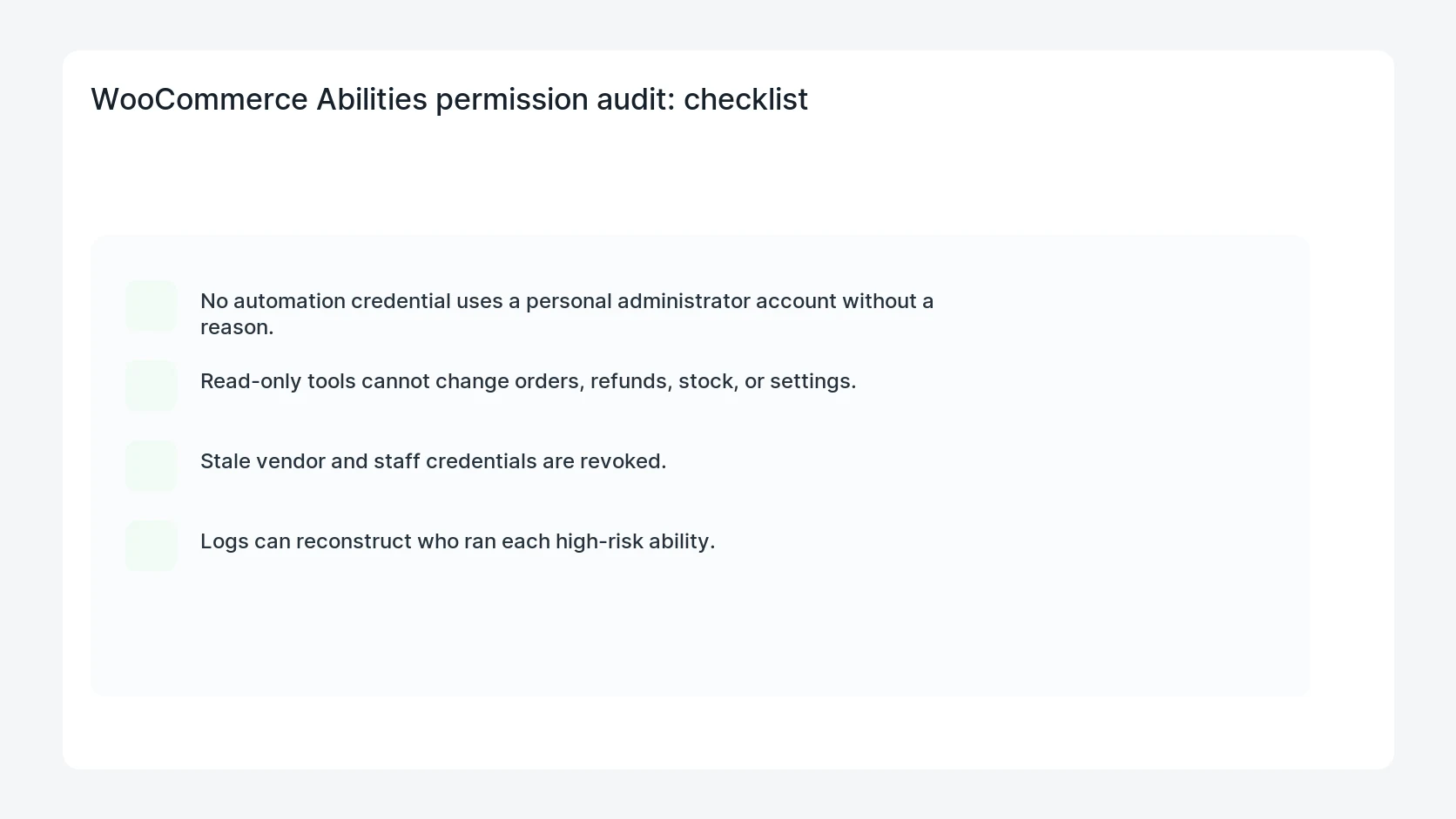
- No automation credential uses a personal administrator account without a reason.
- Read-only tools cannot change orders, refunds, stock, or settings.
- Stale vendor and staff credentials are revoked.
- Logs can reconstruct who ran each high-risk ability.
Mistakes to avoid
- Do not judge the fix by one browser or the homepage only.
- Do not delete evidence before recording usernames, file paths, timestamps, and response headers.
- Do not add a cache, security, or tracking plugin while the original problem is still unclear.
- Do not leave test users, temporary debug logs, or broad API keys active after verification.
When HandL WP should help
Bring in help when this affects leads, checkout, search visibility, malware risk, paid media reporting, or a client production site. HandL WP can trace the issue through WordPress, hosting, cache, tracking, and Search Console, then verify the workflow after the technical fix.
If this is active on a production site, review WooCommerce automation permissions.
Helpful references