AI crawler names in access logs can be useful, but any client can spoof a user-agent string. WordPress teams should compare user agent, IP source, path behavior, WAF result, rate, and robots.txt access before allowing traffic through a firewall.
Use this for WordPress sites that want AI search visibility but also need to protect admin, checkout, account, staging, and high-cost dynamic paths.
Quick answer
AI Crawler Spoofing Detection in WordPress Access Logs should be handled with a narrow evidence-first workflow: group log fields, verify ip source, check crawl pattern, then verify the result before making broader changes.
What to check first
- Group logs by user agent, IP address, ASN when available, path, response code, and request rate.
- Compare crawler IP data against official vendor documentation when a vendor publishes it.
- Check whether the visitor fetches robots.txt and sitemap before crawling many pages.
- Block or challenge traffic that claims to be a crawler while hitting login, checkout, account, or random query-string paths.
- Keep rate limits on public content even when a crawler is allowed.
Diagnostic table
Use this table to keep the work practical. It connects the symptom to evidence and a verification step.
| Action | Evidence to collect | How to verify |
|---|
| Group log fields | Group logs by user agent, IP address, ASN when available, path, response code, and request rate. | Allowed crawler traffic matches the written policy and expected source signals. |
| Verify IP source | Compare crawler IP data against official vendor documentation when a vendor publishes it. | Spoofed crawler traffic does not bypass WAF or rate-limit rules. |
| Check crawl pattern | Check whether the visitor fetches robots.txt and sitemap before crawling many pages. | Public pages, images, CSS, and sitemap remain reachable to allowed crawlers. |
| Protect private paths | Block or challenge traffic that claims to be a crawler while hitting login, checkout, account, or random query-string paths. | Private and transactional paths stay protected. |
Useful command or data shape
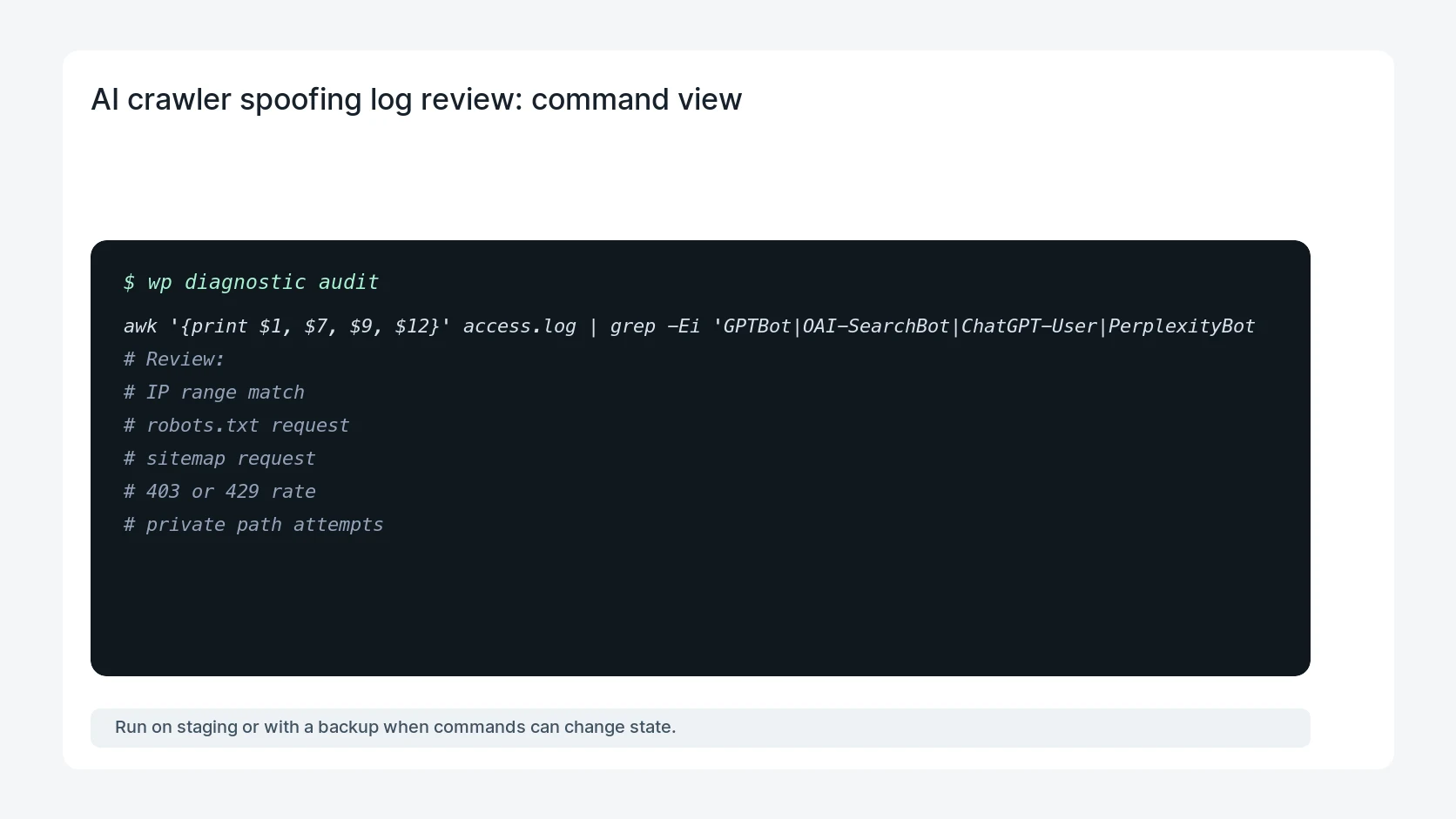
Adapt paths, IDs, and privacy handling to the site before running commands or storing data on production.
awk '{print $1, $7, $9, $12}' access.log | grep -Ei 'GPTBot|OAI-SearchBot|ChatGPT-User|PerplexityBot'
# Review:
# IP range match
# robots.txt request
# sitemap request
# 403 or 429 rate
# private path attempts
Safe fix order
Do the work in a sequence that makes each result easy to prove. Stop if a step produces new evidence that changes the incident scope.
- Group log fields
- Verify IP source
- Check crawl pattern
- Protect private paths
- Keep rate limits
Production verification checklist
- Allowed crawler traffic matches the written policy and expected source signals.
- Spoofed crawler traffic does not bypass WAF or rate-limit rules.
- Public pages, images, CSS, and sitemap remain reachable to allowed crawlers.
- Private and transactional paths stay protected.
Mistakes to avoid
- Do not judge the fix by one browser or the homepage only.
- Do not delete evidence before recording usernames, file paths, timestamps, and response headers.
- Do not add a cache, security, or tracking plugin while the original problem is still unclear.
- Do not leave test users, temporary debug logs, or broad API keys active after verification.
When HandL WP should help
Bring in help when this affects leads, checkout, search visibility, malware risk, paid media reporting, or a client production site. HandL WP can trace the issue through WordPress, hosting, cache, tracking, and Search Console, then verify the workflow after the technical fix.
If this is active on a production site, review WordPress AI crawler logs.
Related HandL WP guides
Use these related guides when the same issue touches tracking, security, checkout, or crawler visibility.
Helpful references