The WordPress 7.0 field guide includes Site Editor and block-related changes, including navigation overlay improvements and template-related updates. Business sites using block themes should test templates, patterns, navigation, forms, and WooCommerce screens before updating production.
Use this when a WordPress site uses a block theme, custom templates, synced patterns, navigation overlays, Full Site Editing, or WooCommerce blocks.
Quick answer
WordPress 7.0 Block Theme Regression Checklist should be handled with a narrow evidence-first workflow: snapshot pages, update staging, test editor pieces, then verify the result before making broader changes.
What to check first
- Snapshot homepage, service pages, blog posts, archives, forms, checkout, and mobile navigation before updating.
- Update WordPress 7.0 on staging with the same theme, plugins, cache, and PHP version as production.
- Test Site Editor templates, template parts, navigation overlays, synced patterns, and custom blocks.
- Check console errors, PHP logs, REST API responses, and failed scheduled tasks.
- Compare mobile, tablet, and desktop screenshots before approving production.
Diagnostic table
Use this table to keep the work practical. It connects the symptom to evidence and a verification step.
| Action | Evidence to collect | How to verify |
|---|
| Snapshot pages | Snapshot homepage, service pages, blog posts, archives, forms, checkout, and mobile navigation before updating. | Critical templates render correctly on mobile and desktop. |
| Update staging | Update WordPress 7.0 on staging with the same theme, plugins, cache, and PHP version as production. | Navigation overlays, patterns, and custom blocks behave as expected. |
| Test editor pieces | Test Site Editor templates, template parts, navigation overlays, synced patterns, and custom blocks. | Forms, checkout, search, and login still work after the update. |
| Read logs | Check console errors, PHP logs, REST API responses, and failed scheduled tasks. | Production rollout has a rollback path for files, database, and cache. |
Useful command or data shape
Adapt paths, IDs, and privacy handling to the site before running commands or storing data on production.
regression_targets:
  templates: home, single, archive, page
  template_parts: header, footer, navigation
  flows: form_submit, checkout, login, search
  viewports: mobile, tablet, desktop
  approval: no visual breaks and no fatal errors
Safe fix order
Do the work in a sequence that makes each result easy to prove. Stop if a step produces new evidence that changes the incident scope.
- Snapshot pages
- Update staging
- Test editor pieces
- Read logs
- Compare viewports
Production verification checklist
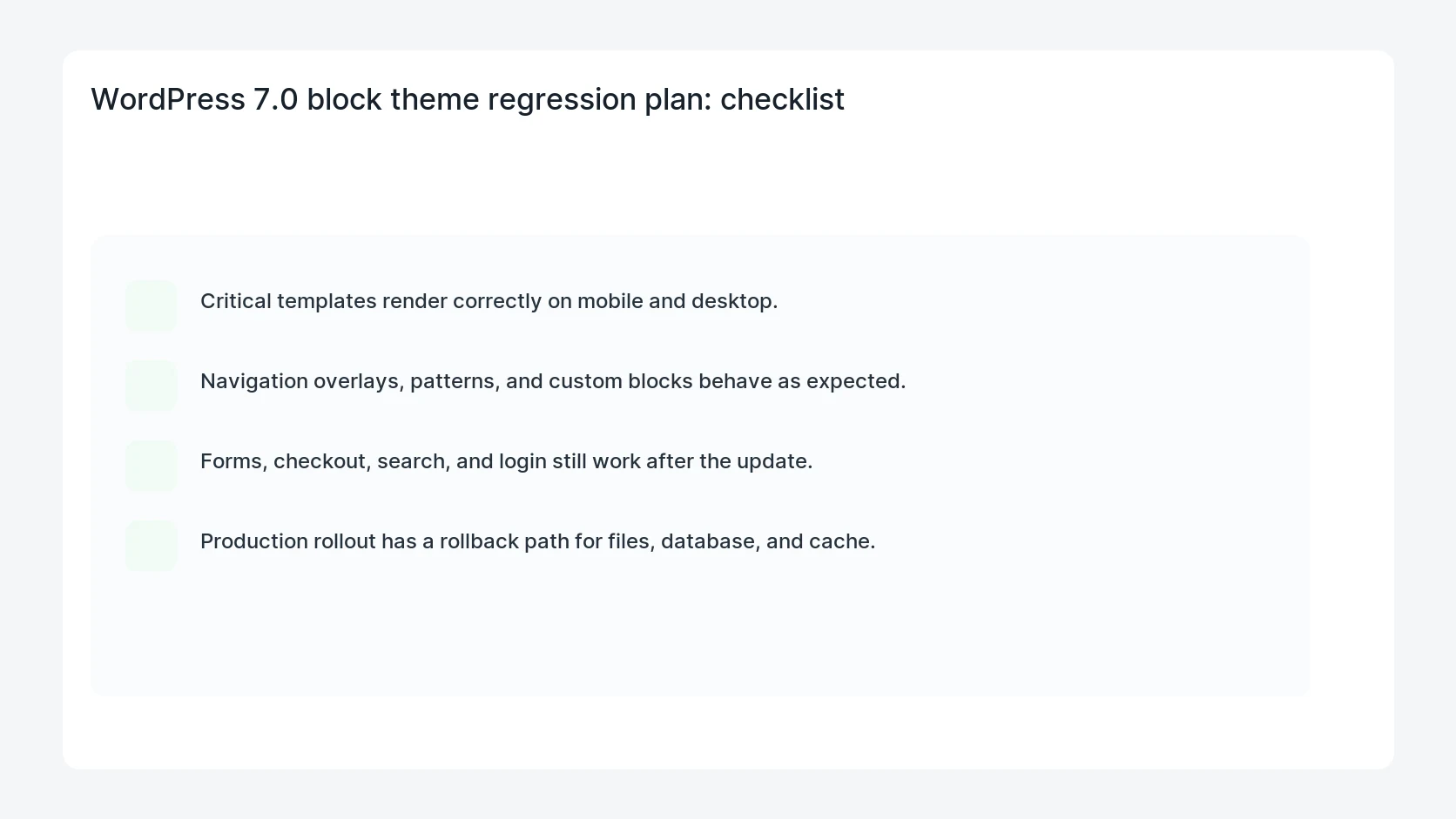
- Critical templates render correctly on mobile and desktop.
- Navigation overlays, patterns, and custom blocks behave as expected.
- Forms, checkout, search, and login still work after the update.
- Production rollout has a rollback path for files, database, and cache.
Mistakes to avoid
- Do not judge the fix by one browser or the homepage only.
- Do not delete evidence before recording usernames, file paths, timestamps, and response headers.
- Do not add a cache, security, or tracking plugin while the original problem is still unclear.
- Do not leave test users, temporary debug logs, or broad API keys active after verification.
When HandL WP should help
Bring in help when this affects leads, checkout, search visibility, malware risk, paid media reporting, or a client production site. HandL WP can trace the issue through WordPress, hosting, cache, tracking, and Search Console, then verify the workflow after the technical fix.
If this is active on a production site, test a WordPress 7.0 update safely.
Helpful references
When a block theme passes the broad regression checks but spacing differs between editing and the public page, isolate the gap configuration with WordPress Block Spacing Differs Between Editor and Live Site.
For a missing or disabled Wide width or Full width option, check which parent layout controls the block: WordPress Wide or Full Width Says Not Available: Check the Parent.
When resetting one control seems to restore the same appearance, trace its inherited source before resetting the whole theme: WordPress Block Styles Come Back After Reset: Trace Inheritance.