React and headless WordPress sites often serve an app shell for unknown URLs. If that shell carries default canonical tags or generic metadata, crawlers can receive mixed signals for archives, missing posts, and duplicate paths.
Use this when a WordPress frontend uses CloudFront, S3, React routing, Lambda prerendering, or custom fallback behavior that may return HTML for missing pages.
Quick answer
WordPress App Shell Canonical Tag Archive Fix should be handled with a narrow evidence-first workflow: compare url classes, count seo tags, fix fallback metadata, then verify the result before making broader changes.
What to check first
- Compare clean blog URLs, archive URLs, missing URLs, and fallback URLs with curl.
- Count title, meta description, canonical, and robots meta tags in the crawler HTML.
- Confirm real pages and fallback shells do not share the same canonical tag.
- Make archive pages useful or noindex them if they stay thin.
- Invalidate affected routes after changing prerender templates or fallback behavior.
Diagnostic table
Use this table to keep the work practical. It connects the symptom to evidence and a verification step.
| Action | Evidence to collect | How to verify |
|---|
| Compare URL classes | Compare clean blog URLs, archive URLs, missing URLs, and fallback URLs with curl. | Real URLs and fallback URLs have different crawler behavior. |
| Count SEO tags | Count title, meta description, canonical, and robots meta tags in the crawler HTML. | Missing pages do not self-canonical as valid articles. |
| Fix fallback metadata | Confirm real pages and fallback shells do not share the same canonical tag. | Thin archives are noindexed or upgraded into useful hubs. |
| Choose archive strategy | Make archive pages useful or noindex them if they stay thin. | The sitemap contains only intended canonical URLs. |
Useful command or data shape
Adapt paths, IDs, and privacy handling to the site before running commands or storing data on production.
curl -sS https://example.com/blog/real-post | grep -Ei '<title>|canonical|robots'
curl -sS https://example.com/blog/missing-post | grep -Ei '<title>|canonical|robots'
curl -sSI https://example.com/blog/missing-post
curl -sS https://example.com/sitemap.xml | grep 'missing-post'
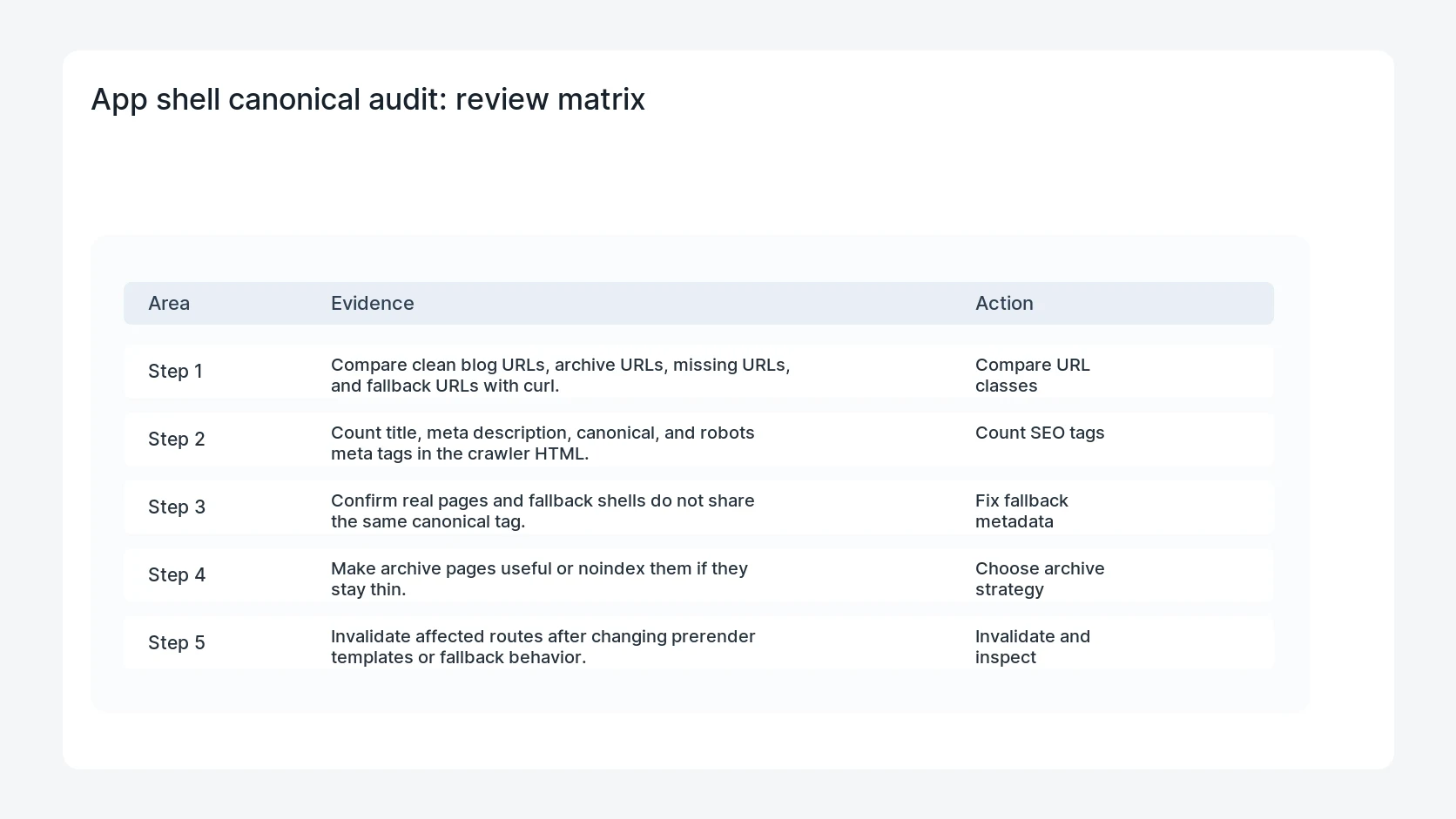
Safe fix order
Do the work in a sequence that makes each result easy to prove. Stop if a step produces new evidence that changes the incident scope.
- Compare URL classes
- Count SEO tags
- Fix fallback metadata
- Choose archive strategy
- Invalidate and inspect
Production verification checklist
- Real URLs and fallback URLs have different crawler behavior.
- Missing pages do not self-canonical as valid articles.
- Thin archives are noindexed or upgraded into useful hubs.
- The sitemap contains only intended canonical URLs.
Mistakes to avoid
- Do not judge the fix by one browser or the homepage only.
- Do not delete evidence before recording usernames, file paths, timestamps, and response headers.
- Do not add a cache, security, or tracking plugin while the original problem is still unclear.
- Do not leave test users, temporary debug logs, or broad API keys active after verification.
When HandL WP should help
Bring in help when this affects leads, checkout, search visibility, malware risk, paid media reporting, or a client production site. HandL WP can trace the issue through WordPress, hosting, cache, tracking, and Search Console, then verify the workflow after the technical fix.
If this is active on a production site, fix WordPress canonical tags.
Related HandL WP guides
Use these related guides when the same issue touches tracking, security, checkout, or crawler visibility.
Helpful references