When a WordPress contact form stops sending emails, the form is not always broken. The failure can be inside the form plugin, WordPress mail handling, SMTP authentication, DNS records, spam filtering, or the receiving mailbox.
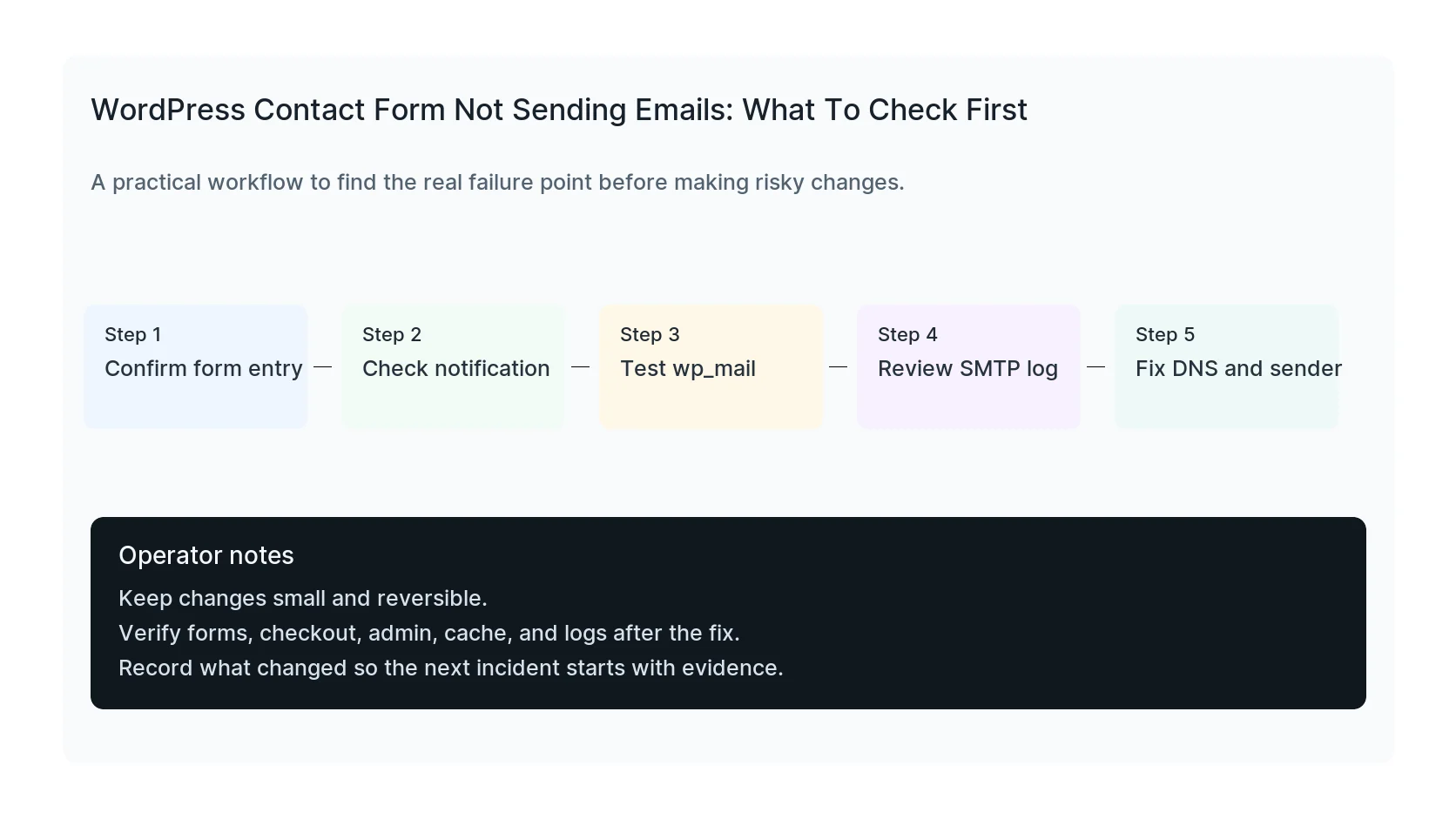
The right fix starts by separating two questions: did WordPress receive the submission, and did the email delivery system send it successfully?
Quick triage map
Use this table before changing the site. It keeps the first response focused on evidence instead of guesses.
| Signal | What it usually means | First useful check |
|---|
| Visitor submits form | Recent change or active failure | Check notification |
| Plugin records entry | Code, plugin, theme, or service layer | Test wp_mail |
| wp_mail called | Business workflow at risk | Fix DNS and sender |
| SMTP relays email | Evidence needed before cleanup | Record timestamp, logs, and exact symptom |
First check whether submissions are being saved
Open the form plugin entries, submissions, or database records. If entries are being saved, the visitor side is probably working and the problem is email delivery. If entries are missing, look for JavaScript errors, caching, spam protection, or a broken form embed.
Do not rely only on your inbox. A form can be collecting leads silently while notifications fail.
- Check the form plugin entry list.
- Submit a test from a private browser window.
- Use a real email address, not a fake test address.
- Check spam, promotions, quarantine, and mailbox rules.
Check the notification settings
Most form email failures are simple configuration problems. A recipient may be wrong, disabled, or using an old address. The From address may use the visitor email, which often fails sender checks.
A safer default is to send from an address on your own domain and put the visitor email in Reply-To.
From: website@example.com
Reply-To: {visitor_email}
To: team@example.com
Test WordPress mail separately
WordPress sends mail through wp_mail(). If wp_mail works but the form does not, the issue is likely in form notifications. If wp_mail fails, move to SMTP, hosting mail limits, or DNS.
A mail logging plugin can show whether WordPress tried to send the message and what error came back from the mailer.
wp option get admin_email
wp plugin list | grep -Ei 'smtp|mail|forms'
Fix sender authentication
Modern inboxes care about SPF, DKIM, and DMARC. If your site sends from an address that is not authenticated, the email can disappear into spam or get rejected before your team sees it.
Use a real SMTP or transactional email provider for business-critical forms. Then align the From domain with the domain that is authenticated in DNS.
- Use a domain-owned From address.
- Authenticate SPF and DKIM.
- Avoid using the visitor email as From.
- Keep Reply-To mapped to the visitor.
- Check provider logs for bounces and rejects.
Watch for caching and JavaScript problems
If the form does not submit at all, inspect the browser console and network tab. Optimization plugins can defer or combine scripts in ways that break reCAPTCHA, AJAX submissions, or form validation.
Temporarily bypass cache for the contact page and test again.
Protect the lead path after the fix
Once emails work again, test the entire lead path. Confirm the site stores the entry, sends the notification, reaches the inbox, sends the thank-you message, and records conversion tracking if ads depend on it.
HandL WP fixes WordPress form delivery issues and verifies the full lead path, not just the mail plugin setting.
If this is active on a production site, fix WordPress contact form email delivery.
Mistakes to avoid
Most WordPress emergencies get worse when too many changes happen at once. Keep the recovery path narrow so you can prove what fixed the problem.
- Do not update more plugins while troubleshooting the current failure.
- Do not delete folders before copying or backing them up.
- Do not judge the fix by the homepage only.
- Do not leave debug logging, disabled security rules, or temporary passwords in place.
- Do not skip the business workflow that originally made the issue urgent.
Production verification checklist
Before calling the issue fixed, verify the site from the visitor side and the admin side. A technical fix that breaks forms, checkout, or tracking is not finished.
- Retest the original symptom: form submissions missing.
- Open the site in a private browser window.
- Check wp-admin or the affected admin screen.
- Test the lead, checkout, booking, or contact path if the site depends on it.
- Review the error log after the fix, not only before it.
- Clear only the cache layers that affect the fixed pages.
- Write down the files, plugins, settings, or credentials changed.
Helpful official references
Separate form mail from post-author comment notifications
When the missing or unexpected message is tied to a comment, use the WordPress 7.1 notify_post_author audit to test approved, pending, spam, trash, invalid-ID, and strict-boolean filter paths.
Trace Gutenberg note mention notifications end to end
Use the Gutenberg 23.8 note mention email audit to join user locale, wp_mail, provider message ID, delivery, duplicate behavior, editor-link permissions, role changes, and privacy evidence.